Zakład Geografii Ekonomicznej
About us
Kierownik Zakładu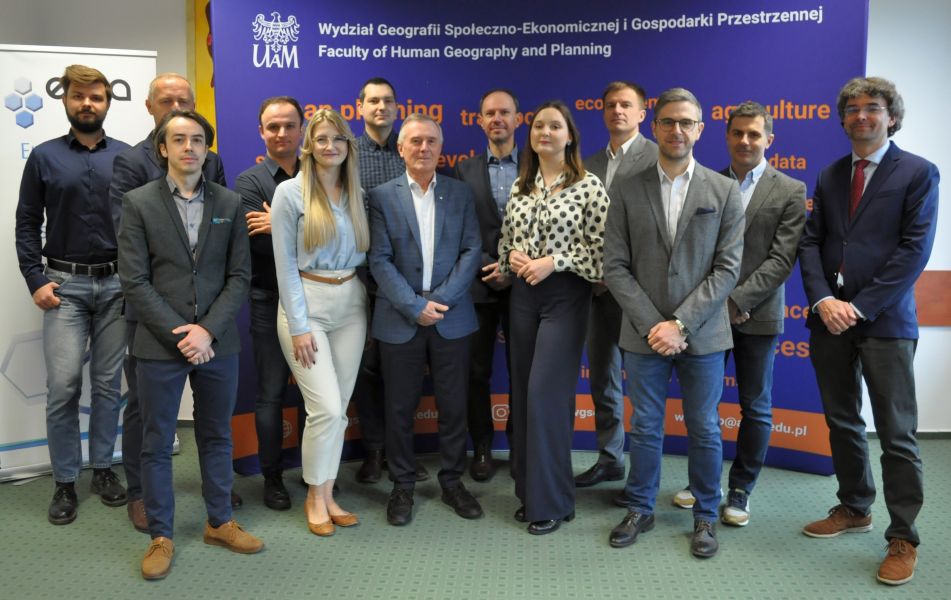
dr hab. Robert Kudłak, prof. UAM
Pracownicy Zakładu
Prof. zw. dr hab. Tadeusz Stryjakiewicz - profesor
dr hab. Bartłomiej Kołsut, prof. UAM
dr hab. Michał Męczyński, prof. UAM
dr hab. Krzysztof Stachowiak, prof. UAM
Problematyka badawcza Zakładu Geografii Ekonomicznej
- Geografia filmu i festiwalizacja przestrzeni miejskiej
- Geografia rynku samochodów osobowych
- Finanse samorządu terytorialnego
- Kurczenie się miast i strategie ich regeneracji
- Polityka miejska i regionalna
- Relacje biznes-społeczeństwo-środowisko przyrodnicze
- Rozwój miast i regionów ze szczególnym uwzględnieniem roli sektora kreatywnego
- Rozwój społeczno-gospodarczy obszaru poradzieckiego
- Transport w warunkach transformacji gospodarczej
Tematy realizowanych rozpraw habilitacyjnych oraz doktorskich
Przemysław Ciesiółka – Modele rewitalizacji miast postsocjalistycznych w różnych uwarunkowaniach instytucjonalnych
Filip Bebenow – Transformacja lokalnych systemów kolei w Polsce w XXI w. w kontekście historycznych przemian transportu kolejowego
Bartosz Doszczeczko – Przemiany transportu indywidualnego i zbiorowego w wybranych aglomeracyjnych w Polsce
Projekty badawcze oraz publikacje naukowe Zakładu Geografii Ekonomicznej
RE-CITY: Reviving shrinking cities – innovative paths and perspectives towards livability for shrinking cities in Europe. Projekt programu Horyzont 2020, okres realizacji: 2018-2023, zespół: prof. UAM dr hab. Krzysztof Stachowiak (kierownik), prof. zw. dr hab. Tadeusz Stryjakiewicz, dr Emilia Jaroszewska, dr Bartłomiej Kołsut, dr inż. Przemysław Ciesiółka,
Przestrzenny wymiar (r)ewolucji na rynku samochodowym w Polsce, okres realizacji: 2017-2020, Grant NCN – Opus, lata 2017-2020, kierownik prof. dr hab. Tadeusz Stryjakiewicz, skład zespołu badawczego: Tadeusz Stryjakiewicz (kierownik), Robert Kudłak, Jędrzej Gadzińki, Wojciech Kisiała, Bartłomiej Kołsut, Wojciech Dyba
RURACTION. Projekt programu Horyzont 2020, okres realizacji: 2017-2020, kierownik polskiego zespołu badawczego: Tadeusz Stryjakiewicz
FilmInd: The Indian film industry as a driver of new socio-economic connections between India and Europe. Projekt finansowany w ramach konkursu EqUIP (EU-India Platform for Social Sciences and Humanities), kierownik: Prof. UAM dr hab. Krzysztof Stachowiak
Rola infrastruktury transportu publicznego w kształtowaniu struktur przestrzennych i zachowań komunikacyjnych na obszarach zurbanizowanych. Grant NCN – Sonata, lata 2016-2019, kierownik: Jędrzej Gadziński
Integracja czy dezintegracja systemów społeczno-ekonomicznych na obszarze postradzieckim w świetle koncepcji terytorialnego systemu społecznego. Grant NCN/2011-16, członek zespołu badawczego: Julia Kaczmarek-Khubnaia
Przepływy wiedzy w klastrach meblarskich w Polsce Zachodniej i na obszarze „Trzecich Włoch” oraz ich rola w adaptacji firm do zmian rynkowych wywołanych ogólnoświatowym kryzysem gospodarczym. Grant NCN – Preludium nr 2015/17/N/HS4/00205, kierownik: Wojciech Dyba
Mechanizmy funkcjonowania i rozwoju gospodarki kreatywnej. Grant NCN – Opis nr 2011/03/D/HS4/01662, kierownik: Krzysztof Stachowiak
Książki
- Kaczmarek-Khubnaia J., 2023. Gruzja i jej regiony na poradzieckiej ścieżce rozwoju społeczno-gospodarczego: uwarunkowania, poziom oraz dynamika procesu. Bogucki Wydawnictwo Naukowe, Poznań.
- Kołsut B., Stryjakiewicz T. (red.), 2023. The Economic Geography of the Car Market. The Automobile Revolution in an Emerging Economy. London, Routledge Taylor & Francis Group.
- Stachowiak K., Janta H., Kozina J., Sunngren-Granlund T. (red.), 2023. Film and place in an intercultural perspective: India-Europe film connections. Routledge, London. https://doi.org/10.4324/9781003293347
- Kudłak R., Barkemeyer R., Preuss L., Heikkinen A. (red.), 2022. The Impact of Corporate Social Responsibility: Corporate Activities, the Environment and Society. Routledge, New York. https://doi.org/10.4324/9781003182276
- Wu C.-T., Gunko M., Stryjakiewicz T., Zhou K. (red.), 2022. Postsocialist Shrinking Cities, Routledge. https://doi.org/10.4324/9780367815011
- Jaroszewska E., 2019. Kurczenie się (shrinkage) starych miast przemysłowych i przeciwdziałanie jego negatywnym skutkom. Krajowy Instytut Polityki Przestrzennej i Mieszkalnictwa, Warszawa-Kraków.
- Kudłak R., 2018. Instytucjonalne uwarunkowania społecznej odpowiedzialności biznesu. Wydawnictwo Naukowe UAM.
- Męczyński M., 2018. Klasa kreatywna i jej warunki pracy w wybranych aglomeracjach miejskich Europy. Studium porównawcze Birmingham, Lipska i Poznania. Studia i Prace z Geografii, Bogucki Wydawnictwo Naukowe, Poznań.
Artykuły naukowe
- Ciesiółka P., Churski P., Mikuła Ł., Kołsut B., 2023. Model struktury funkcjonalno-przestrzennej w strategii rozwoju ponadlokalnego, Studia Regionalne i Lokalne, 2023(1): 7-22. https://doi.org/10.7366/1509499519101
- Dyba W., Di Maria E., 2023. Assessment and support of the digitalisation of businesses in Europe during and after the COVID-19 pandemic. Regional Science Policy & Practice, 2023: 1-16. https://doi.org/10.1111/rsp3.12717
- Ciesiółka P., Maćkiewicz B., 2022. In Search of Social Resilience? Regeneration Strategies for Polish Cities. Sustainability, 14(19): 11969. https://doi.org/10.3390/su141911969
- Dyba W., Di Maria E., Chiarvesio M., 2022. Actions fostering the adoption of Industry 4.0 technologies in manufacturing companies in European regions. Investigaciones Regionales – Journal of Regional Research, 2022/2(53): 27-46. https://doi.org/10.38191/iirr-jorr.22.009
- Dyba W., De Marchi, V., 2022. On the road to Industry 4.0 in manufacturing clusters: the role of business support organizations. Competitiveness Review, 32(5): 760-776.
https://doi.org/10.1108/CR-09-2021-0126 - Kołsut B., Stryjakiewicz T., Gadziński J., 2022. Do Motorisation Statistics Reflect the Real Geography of Car Ownership in Poland? Quaestiones Geographicae, 41(2): 95-108. https://doi.org/10.2478/quageo-2022-0016
- Kołsut B. Stryjakiewicz T., 2021. Do Spatial Differences in the Personal Car Market Reflect a Centre-Periphery Structure? The Case of Poland. European Transport Research Review, 13(1): 1-12. https://doi.org/10.1186/s12544-021-00494-2
- Stryjakiewicz T., 2021. Emergence of socio-economic geography and spatial management as a scientific discipline in the new classification of science in Poland. Quaestiones Geographicae, 40 (4): 7-14. https://doi.org/10.2478/quageo-2021-0033
- Stryjakiewicz T., Kołsut B., Doszczeczko B., Dyba W., Kisiała W., Kudłak R., Wojtyra B., 2021. Przegląd ekonomiczno-przestrzennych badań rynku samochodów osobowych. Przegląd Geograficzny, 93, 2: 249-268. https://doi.org/10.7163/PrzG.2021.2.6.
- Ciesiółka P., Gunko M, Pivovar G., 2020. Who defines urban regeneration? Comparative analyses of medium-sized cities in Poland and Russia. Geographia Polonica, 93: 245-259. https://doi.org/10.7163/gpol.0172
- Ciesiółka P., Maćkiewicz B., 2020 From regeneration to gentrification: Insights from a Polish city. People, Place and Policy Online, 14(3): 199-215. https://doi.org/10.3351/ppp.2020.2955385256
- Dyba, W., Stryjakiewicz, T., De Marchi, V., 2020. Knowledge sourcing and cluster life cycle – a comparative study of furniture clusters in Italy and Poland. European Planning Studies, 28: 1979-1998. https://doi.org/10.1080/09654313.2019.1701996
- Hennebry B., Stryjakiewicz T., 2020. Classification of structurally weak rural regions: Application of a rural development index for Austria and Portugal. Quaestiones Geographicae, 39(2): 5-14. https://doi.org/10.2478/quageo-2020-0014
- Jaroszewska E., Stryjakiewicz T., 2020. Drivers, Scale, and Geography of Urban Shrinkage in Poland and Policy Responses. Journal of Urban Planning and Development, 146(4). https://doi.org/10.1061/(ASCE)UP.1943-5444.0000601
- Kaczmarek-Khubnaia J., 2020. Agriculture in Georgia − the condition of the sector and its importance in the process of socio-economic development of the country and its regions. Journal of Geography, Politics and Society, 10(2): 35–44. https://doi.org/10.26881/jpgs.2020.2.05
- Kołsut B., Gadziński J., Stryjakiewicz T., 2020. Ułomności statystyki motoryzacji w Polsce i ich konsekwencje dla badań geograficznych. Przegląd Geograficzny, 92(2): 227-245. https://doi.org/10.7163/PrzG.2020.2.4
- Novikova M., Ferreiro de Fátima M., Stryjakiewicz T., 2020. Local development initiatives as promoters of social innovation: Evidence from two european rural regions. Quaestiones Geographicae, 39(2): 43-53.
- Kudłak R., 2019. The role of CSR in predicting the CO2 emission: an institutional approach. Ecological Economics, 163: 169-176. https://doi.org/10.1016/j.ecolecon.2019.04.027Męczyński M., Ciesiółka P., 2022. Regional green transition: Cases of Polish and Russian regions. Quaestiones Geographicae, 41(4): 165–177. https://doi.org/10.14746/quageo-2022-0036
- Radzimski A., Gadziński J., 2019. Travel behaviour in post-socialist city. European Spatial Research and Policy, 26: 43-60. https://doi.org/10.18778/1231-1952.26.1.03
- Abbasiharofteh M., Dyba W., 2018. Structure and significance of knowledge networks in two low-tech clusters in Poland. Regional Studies, Regional Science, 5, 1:108-116. https://doi.org/10.1080/21681376.2018.1442244
- Ciesiółka P. 2018. Urban Regeneration as a New Trend in the Development Policy in Poland. Quaestiones Geographicae, 37/2: 109-123 https://doi.org/10.2478/quageo-2018-0015
- Dyba W., Loewen B., Looga J., Zdražil P., 2018. Regional development in Central-Eastern European Countries at the beginning of the 21st century: Path dependence and effects of EU Cohesion Policy. Quaestiones Geographicae, 37(2): 77-92. https://doi.org/10.2478/quageo-2018-0017
- Gadziński J., 2018. Perspectives of the use of smartphones in travel behaviour studies: findings from a literature review and a pilot study. Transportation Research Part C: Emerging Technologies, 88: 74-86. https://doi.org/10.1016/j.trc.2018.01.011
- Kołsut B., 2018. National associations of municipalities in Europe - different models of institutionalized political cooperation. Geography, Environment, Sustainability, 11(4): 39-55. https://doi.org/10.24057/2071-9388-2018-11-4-39-55.
- Kudłak R., Szőcs I., Krumay B., Martinuzzi A., 2018. The future of CSR-Selected findings from a Europe-wide Delphi study. Journal of Cleaner Production, 183: 282-291. https://doi.org/10.1016/j.jclepro.2018.02.119
- Stachowiak K., Stryjakiewicz T., 2018, The rise of film production locations and specialised film services in European semi-peripheries. Hungarian Geographical Bulletin, 67, 3: 223-237. https://doi.org/10.15201/hungeobull.67.3.2
- Stryjakiewicz T., Kudłak R., Ciesiółka P., Kołsut B., Motek P. 2018. Urban regeneration in Poland’s non-core regions. European Planning Studies, 26, 2: 316-341 https://doi.org/10.1080/09654313.2017.1361603
Rozdziały w książkach
- Balcerak M., Stachowiak K., Adamczak M., 2023. Production culture, interpersonal relations and the internationalisation of filmmaking industry: The case of Indian film productions in Poland. W: Stachowiak K., Janta H., Kozina J., Sunngren-Granlund T. (red.), Film and place in an intercultural perspective: India-Europe film connections. Routledge, London: 159-178. https://doi.org/10.4324/9781003293347
- Dyba W., 2023. Hybrid and Electric Cars: Rare Novelty for Elites or a Future Ubiquitous Good? W: B. Kołsut, T. Stryjakiewicz (red.), The Economic Geography of the Car Market: The Automobile Revolution in an Emerging Economy. Routledge, New York: 127-158.
- Dyba W., Doszczeczko B., 2023. Car use and alternative mobility solutions as a reflection of urban sprawl and marginalisation of rural areas. W: Kołsut, B., Stryjakiewicz, T. (red.), The Economic Geography of the Car Market: The Automobile Revolution in an Emerging Economy. Routledge, New York. https://doi.org/10.4324/9781003309659
- Kisiała W., Kudłak R., Kołsut B., 2023. The market for new cars: Another dimension of the core-periphery pattern. W: B. Kołsut, T. Stryjakiewicz (red.), The Economic Geography of the Car Market: The Automobile Revolution in an Emerging Economy, Routledge, New York: 25-44. https://doi.org/10.4324/9781003309659
- Kołsut B., Kudłak R., Kisiała W., 2023. The import of second-hand cars: evidence of individual entrepreneurship and social networks. W: B. Kołsut, T. Stryjakiewicz (red.), The Economic Geography of the Car Market: The Automobile Revolution in an Emerging Economy, Routledge, New York. https://doi.org/10.4324/9781003309659
- Kudłak R. 2022. Models of capitalism, institutions and corporate social responsibility. W: C. Simoes, A. Stancu, G. Grigore (red.), Corporate Responsibility, Sustainability and Markets. How Ethical Organisations and Consumers Shape Markets. Palgrave MacMillan, Cham: 233-252. https://doi.org/10.1007/978-3-030-79660-0_12
- Kudłak R., Kołsut B., Kisiała W., 2023. Driving gears of car ownership transformation. W: B. Kołsut, T. Stryjakiewicz (red.), The Economic Geography of the Car Market: The Automobile Revolution in an Emerging Economy, Routledge, New York. https://doi.org/10.4324/9781003309659
- Stryjakiewicz T., Kołsut B., 2023. Why is Poland such an intriguing case study of the automobile revolution in an emerging economy? W: B. Kołsut, T. Stryjakiewicz (red.), The Economic Geography of the Car Market: The Automobile Revolution in an Emerging Economy, Routledge, New York. https://doi.org/10.4324/9781003309659
- Wojtyra B., Kudłak R., 2023. How the automobile revolution affects the natural environment. W: B. Kołsut, T. Stryjakiewicz (red.), The Economic Geography of the Car Market: The Automobile Revolution in an Emerging Economy, Routledge, New York: 160-176. https://doi.org/10.4324/9781003309659
- Kudłak R., 2022. What do we know about social and environmental impacts of corporate social responsibility? W R. Kudłak, R. Barkemeyer, L. Preuss, A. Heikkinen (red.), The Impact of Corporate Social Responsibility: Corporate Activities, the Environment and Society. Routledge, New York: 14-43. https://doi.org/10.4324/9781003182276
- Kudłak R., Barkemeyer R., Preuss L., Heikkinen A., 2022. Introduction: The Need for a book on CSR Impacts. W: R. Kudłak, R. Barkemeyer, L. Preuss, A. Heikkinen (red.), The Impact of Corporate Social Responsibility: Corporate Activities, the Environment and Society. Routledge, New York: 1-13. https://doi.org/10.4324/9781003182276
- Stachowiak K., Stryjakiewicz T., 2022. Urban mindware in governing post-socialist shrinking cities. W: Pallagst K., Bontje M., Cunningham Sabot E., Fleschurz R. (red.), Handbook on shrinking cities. Edward Elgar, Cheltenham: 134-147. https://doi.org/10.4337/9781839107047.00020
- Stryjakiewicz T., 2022. Shrinking cities in postsocialist countries of Central-Eastern and South-Eastern Europe: A general and comparative overview. W: Wu C.-T., Gunko M., Stryjakiewicz T., Zhou K. (red.) Postsocialist Shrinking Cities, Routledge: 235-255. https://doi.org/10.4324/9780367815011
- Stryjakiewicz T., Jaroszewska E. 2022. Shrinking cities in Poland – recent trends of change and emerging policy responses. W: Wu C.-T., Gunko M., Stryjakiewicz T., Zhou K. (red.), Postsocialist Shrinking Cities, Routledge: 256-275. https://doi.org/10.4324/9780367815011
- Stryjakiewicz T., Kołsut B., 2022. Car Market Transformation. W: P. Churski, T. Kaczmarek (red.), Three Decades of Polish Socio-Economic Transformations Geographical Perspectives. Springer: 155-169. https://doi.org/10.1007/978-3-031-06108-0
- Stachowiak K., 2020. Interplay of the local and the global in connecting creative clusters around the globe. W: Komorowski M., Picone I. (red.), Creative cluster development: Governance, place-making and entrepreneurship. Routledge, London: 66-82. https://doi.org/10.4324/9780429319020
- Kudłak R., 2019. CSR in Poland: The rise and development of corporate social responsibility. W: B. Schlegelmilch, I. Szőcs (red.), Rethinking Business Responsibility in a Global Context: Challenges to Corporate Social Responsibility, Sustainability and Ethics. Springer Nature, Switzerland: 135-146. https://doi.org/10.1007/978-3-030-34261-6_9